
IEEE 802.11
- WiFi technology is half duplex: can either receive or transmit, but cannot do both simultaneously.
- Original IEEE 802.11 standard to spread transmission (better resistance to noise, interference and jamming):
- DSSS: Direct-Sequence Spread-Spectrum
- FHSS: Frequency Hopping Spread-Spectrum
- IEEE 802.11 uses Carrier Sense Multiple Access with Collision Avoidance (CSMA/CA)
- Listen for a period of time, if there’s no transmission then they will transmit, otherwise restart process.
- Hidden Node Problem:
- When two nodes / devices are out of range of each other’s CSMA/CA, causing a collision.
- Request to Send / Clear to Send (RTS/CTS): Access Point only allows one node to send.
IEEE
- IEEE - scientists, engineers and other professionals
- IEEE 802 committee - develops Local Area Network (LAN) standards and Metropolitan Area Network (MAN) standards. These include Ethernet, Token Ring, Wireless LAN, Bridging, and Virtual Bridged LANs.
- IEEE 802.11 WLAN - wireless LAN (WLAN) with multiple amendments - focus on bottom two layers of the OSI model - the physical layer (tranmission of digital bits), MAC layer (data link layer)
- Define the protocols required to communicate over a particular layer
IEEE 802.11 Standard(s)
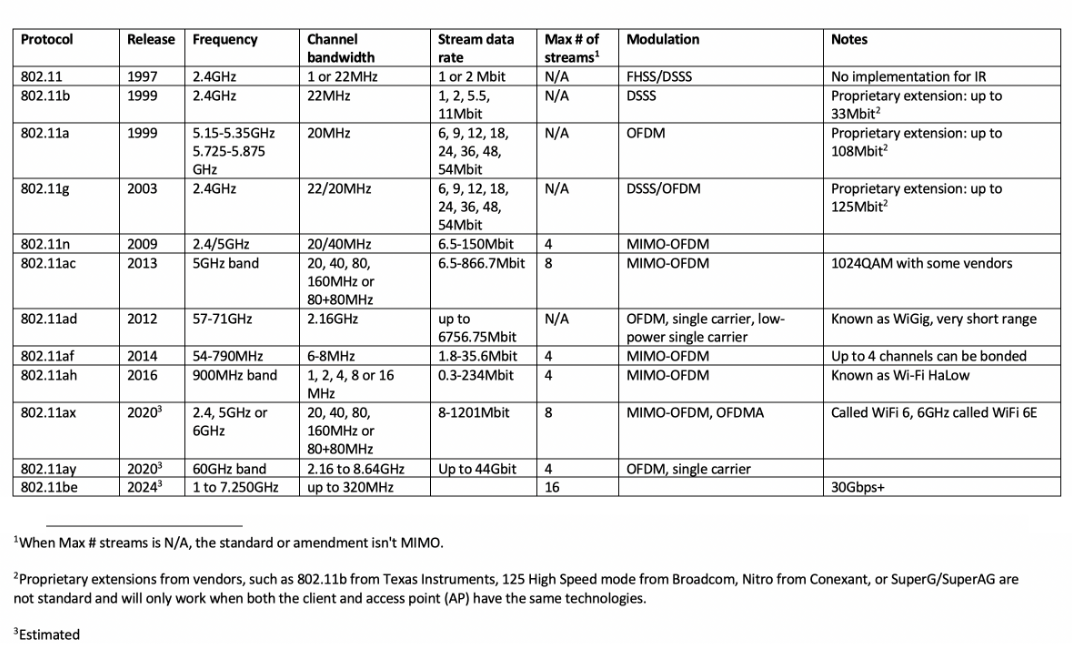
A wireless transmission at 2.4 GHz provides internet to a larger area but sacrifices the fast internet speed, while 5 GHz provides faster speeds but restricts itself to a smaller area.
-
IEEE 802.11 - The original WLAN standard
-
IEEE 802.11b - Complementary Code Keying (CCK), providing 5.5 and 11 Mbit/s rates on the 2.4 GHz band (operating from 2.4 GHz to 2.485 GHz) on 14 channels.
-
IEEE 802.11a - 5GHz band, less crowded spectrum, multiple subchannels/subcarriers/tones to send frequencies at once, OFDM
-
IEEE 802.11g - OFDM for 2.4GHz, backwards compatible with 802.11b
802.11a/b/g is Single Input Single Output (SISO)
- IEEE 802.11n - MIMO techonology on 2.4 and 5GHz networks
- Multiple antennas each with transmitter and receiver
- Up to four spatial streams (streams in WiFi) and equivalent number of antennas
- Greenfield mode - preamble for 802.11n, wait before signal hits networking device
- MIMO: 2x2:2 (2T2R) - 2 TX, 2 RX, 2 streams
- Need more streams to decode information
- MCS:
- Coding rate: how many bits transfer information and how many are used for error correction. Higher values (e.g. ⅚) transfer more information, but there is less room for error correction.
- HT40+/HT40- channels:
- HT20 (20 MHz High Throughput)
- Channel 1 HT40+ = Channel 1 HT20 + Channel 5 HT20 (no overlap)
- IEEE 802.11ac
- 5GHz range, allows beamforming (beam steering of radio frequency transmission in the direction of devices)
- QAM (Quadrature Amplitude Modulation)
- How many possibilities at one time - harder to decode signals without higher quality hardware + signal
- IEEE 802.11ad
- Also known as WiGig
- Uses the 60 GHz bands - much less frequency but stronger intensity
- IEEE 802.11ax
- Builds on “ac” for the 2.4 GHz range
- 1024QAM + MU-OFDMA
- IEEE 802.11h
- Added modification to 5GHz bands.
- 5 GHz spectrum that is also used by radars, thus need to avoid interference.
- An Enterprise access point will scan for 60 seconds to determine if radar exists.
Antenna Diversity vs MIMO
- Antenna diversity - use of two antennas to improve a signal (old, part of a/b/g)
- Multipath propagation bounces objects to change the path. The receiver will take the strongest signal. Antenna diversity will check the antenna with the strongest signal.
- MIMO - use of two or more antennas to transmit and receive (n+)
- Splits data into multiple streams and uses multiple antennas to send. Receiver will then combine the streams.
- Different to Space-Time Block Code, where instead of splitting a signal into multiple parts, the STBC duplicates it across multiple antennas.